
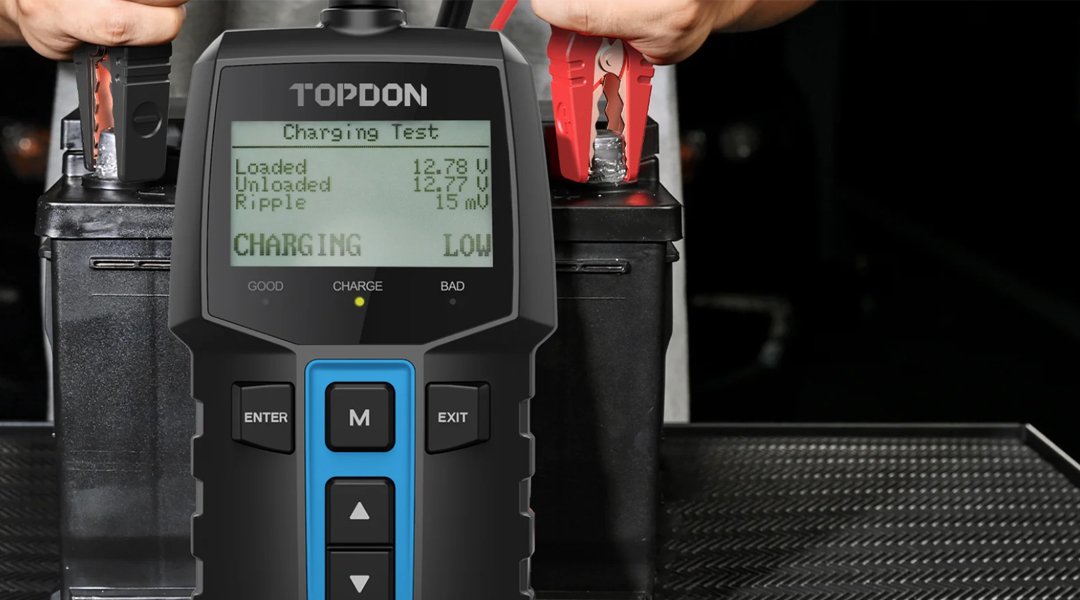
If you need a simple, affordable way to check a 12-volt lead-acid battery (car, truck, motorcycle, boat, ATV), the ANCEL BA101 and the TOPDON BT100 are two of the most common pocket-friendly options available on the end markets. The analyses compare them side-by-side — what they measure, how they feel to use, who each one suits best, plus a clear recommendation at the end for reference.
Battery Tester Comparison: ANCEL BA101 vs TOPDON BT100
| Feature / Attribute | ANCEL BA101 | TOPDON BT100 | Recommendation / Notes |
|---|---|---|---|
| Battery System Supported | 12 V lead-acid (typical car/truck/boat batteries) | 12 V lead-acid — regular flooded, AGM, EFB, GEL | If you use or expect to test AGM, GEL or newer battery chemistries, TOPDON BT100 offers clearer compatibility. |
| CCA (Cold Cranking Amps) Test Range | Suitable for most passenger vehicles, trucks, boats, etc. | 100–2000 CCA (typical range for many vehicles) | Both cover standard vehicle battery needs; TOPDON gives a more explicit numeric range. |
| Metrics Reported | Voltage, cranking, charging tests; basic battery status / health (CCA-based) | Voltage, SOC (State of Charge), SOH (State of Health), CCA, current — more diagnostic detail | For quick go/no-go checks, ANCEL BA101 is fine; for deeper insight into battery health, TOPDON BT100 is preferable. |
| Display / Usability | Compact, backlit LCD; lightweight, small and easy to handle | Digital display with SOH/SOC and detailed readouts; slightly heavier | For portability and simple testing, ANCEL feels more lightweight. For more diagnostic detail, TOPDON wins. |
| Safety & Protection Features | 4-in-1 “Safety Shield Pro” (reverse polarity, short circuit, overcurrent/overvoltage) | Standard clamp-style connections; listing emphasizes compatibility and reliability | If safety and wiring protection are important, ANCEL’s explicit safety messaging gives some reassurance. |
| Ideal Use Case | Quick voltage/CCA/crank checks on standard 12 V batteries — good for routine maintenance or occasional battery checks | More comprehensive battery diagnostics including health, charge level, and support for various battery chemistries — useful for modern vehicles, AGM/GEL batteries, or frequent monitoring | Choose based on whether you want simple checks (ANCEL) or detailed diagnostics and broader chemistry support. |
| Overall Verdict | Great “go/no-go” tester, compact and straightforward — recommended for users wanting fast checks | More feature-rich tester with health metrics and broader battery compatibility — recommended for users needing more diagnostic detail and future-proofing | For most basic uses, ANCEL BA101 suffices; for battery-health tracking and modern battery types, TOPDON BT100 is the stronger tool. |
Short Recommendation Summary
- Go with ANCEL BA101 if your primary goal is a simple, portable, reliable 12 V battery tester for routine maintenance — quick voltage, cranking and charging checks.
- Choose TOPDON BT100 if you want deeper diagnostics, battery-health tracking (SOH/SOC), and broader compatibility (flooded, AGM, GEL, EFB) — especially useful if you own modern vehicles or multiple battery-type systems.
Practical guidelines for choosing a 12V battery tester
Below are clear, usable rules and a short checklist to help you pick the right battery tester for your needs — plus quick testing tips, maintenance notes, and safety reminders.
1) Match the tester to your battery types
- Check chemistry compatibility: If you have modern cars or deep-cycle systems, choose a tester that explicitly supports AGM, GEL, EFB, and flooded batteries.
- CCA range: Make sure the tester’s CCA (Cold Cranking Amps) range covers your vehicle(s). Passenger cars typically need ~200–800 CCA; trucks, marine and performance batteries can require much higher ranges.
2) Decide how deep you want the diagnostics
- Basic / quick checks: Voltage + CCA + crank/charging tests (good for occasional DIYers).
- Intermediate diagnostics: SOC (State of Charge) and SOH (State of Health) readouts — helpful if you want interpretive guidance on whether to recharge, service, or replace.
- Advanced / professional: Load-test capability, graphing, and data-logging, plus compatibility with multiple battery chemistries, are worth it for shops or fleet owners.
3) Accuracy, calibration & trust
- Look for specs & certifications: Accuracy claims (e.g., ±x%) and any test/certification information are useful.
- Calibration & verification: Choose testers from manufacturers that describe calibration or provide an easy calibration procedure. For critical uses, verify results with a known-good meter or professional bench tester.
4) Practical usability features
- Display: Backlit, readable numeric/SOH/SOC display with clear pass/fail indicators.
- Clips & cables: Heavy-duty, insulated clamps; decent cable length (3–6 ft) for reaching batteries in tight engine bays.
- Portability & durability: Rugged housing and lightweight if you’ll carry it.
- Power method: Battery-powered vs. self-powered — prefer self-powered or with independent power so the tester won’t give false negatives on very weak batteries.
5) Important safety protections
- Reverse polarity protection, short-circuit protection, and over-current/over-voltage guards are must-haves. Also look for insulated clamps and clear manufacturer safety instructions.
6) Workflow & real-world checks
- How you’ll use it matters: For a driveway DIYer who tests periodically, a simple, low-cost reader with clear pass/fail is best. For someone who checks dozens of batteries monthly (fleet/shop), invest in a model with SOH/SOC, load test, and data logging.
- Frequency: Test batteries seasonally (spring/fall) and any time you experience starting/charging issues. Test immediately after charging or after a known discharge event to assess recovery.
7) Value & warranty
- Warranty & support: Prefer brands with clear warranty terms and accessible support.
- Value vs. features: Don’t overpay for pro features you’ll never use; conversely, don’t buy the cheapest model if you need chemistry support or accurate SOH/SOC reporting.
8) Interpreting results — quick rules
- Voltage ≈ 12.6V (fully charged, resting).
- SOC/SOH %: SOC tells charge level; SOH estimates remaining useful life. <50% SOH → strongly consider replacement.
- CCA reading: compare to original battery CCA rating; if measured CCA is significantly lower (>20–30% drop) the battery is likely near end of life.
9) When to get professional help
- If a tester reports mixed/ambiguous results, or if vehicle has repeated starting/charging faults, get a bench test at an auto shop or have the alternator and parasitic drains professionally checked.
More articles for the topic
Tesla vs. Toyota: A Battle of Strategies and Future Integration
How Code Is Breaching the Century-Old Walls of the Auto Industry