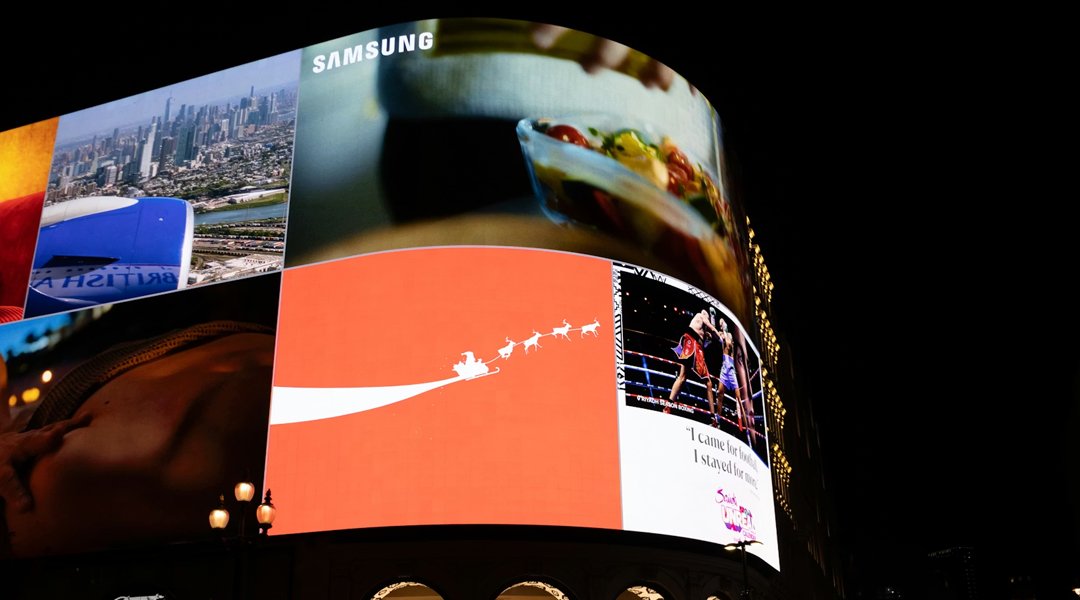

Editor’s Note: When screens become thin, transparent and flexible enough to roll, stretch, or adhere like wallpaper—when information no longer depends on a discrete panel but is delivered by light fields, holograms, or neural signals—does the concept of “display” itself vanish? In this final installment, we move beyond roadmaps and business models to explore the outer limits of display evolution: a future in which interfaces are invisible and information and material reality merge. This is both a technological forecast and a philosophical reflection on perception, spatial design, and human existence.
I. The Dawn of Media-Free Display: Light Fields and Holography
The dream of screenless display—long relegated to science fiction—has entered labs and select commercial settings. The core technical challenge remains: generating realistic, multi-view 3D imagery in free space that satisfies human binocular cues and can be seen without a supporting surface.
From voxel rendering to computational holography. Light-field systems reconstruct 3D imagery by emitting directional light that converges into volumetric “voxels.” Current implementations show compelling depth and parallax but remain large, costly, and constrained in resolution and viewing angle—making them suitable today for exhibitions and specialized applications.
Computer-generated holography (CGH) promises the most faithful reconstruction of three-dimensional light fields by precisely shaping wavefronts with spatial light modulators. Recent algorithmic advances have dramatically accelerated CGH computation, bringing real-time rendering closer to practical deployment. Progress on optics, algorithms and compute architectures will determine how rapidly these methods migrate from niche professional markets (medical visualization, automotive HUDs) into mainstream consumer environments. Expect broader professional adoption within five to ten years; consumer living-room grade solutions may take longer.
II. Materialized Displays: Surfaces That Are the Interface
A parallel path avoids projection entirely: make materials themselves display information. Two families of technologies are driving this shift.
Structural color and electrochromic surfaces. Inspired by nature’s photonic structures, structural-color technologies create color through nanoscale patterns rather than pigments. Electrochromic films and voltage-responsive microstructures enable low-power, large-area color modulation without backlights. These approaches suit adaptive façades, dynamic automotive finishes and programmable textiles where low energy consumption and ambient integration are priorities.
Electronic textiles and wearable displays. Integrating luminescent fibers and printed electronics into fabrics offers the most natural wearable displays: navigation cues on backpacks, status indicators in workwear, or expressive garments for performance and safety applications. Engineering tradeoffs—washability, brightness, flexibility and lifetime—currently limit mass adoption, but targeted professional and premium markets are likely first commercial milestones.
III. Displays as Infrastructure: Buildings, Energy and Information
Displays will increasingly fuse with the built environment and its energy systems, becoming part of a city’s informational and ecological fabric.
Self-powered façades and transparent photovoltaics. Transparent photovoltaic coatings and integrated solar materials can convert façades and windows into both display surface and energy source—reducing operational costs and enabling self-powered signage or dynamic glazing that responds to diurnal cycles.
Media façades and responsive architecture. When façades become programmable—melding electrochromic glass, embedded LEDs and mechanical elements—they transform architecture into a real-time interface for urban data, environmental sensing and public art. Smart buildings will not only conserve energy through adaptive transmittance, they will also communicate air quality, traffic conditions or civic events, creating a dialogue between city, nature and people.
IV. Neural Interfaces: The Most Radical Disruption
Bypassing external senses to deliver image signals directly to the visual cortex represents the most fundamental—and controversial—alternative to traditional displays.
Scientific status and constraints. Animal studies have shown that cortical stimulation can evoke simple percepts, and non-visual BCI applications (cursor control, prosthetic guidance) are already in clinical use. Yet the human visual system’s bandwidth and spatial complexity make high-fidelity cortical vision a formidable technical challenge. Many approaches remain invasive, and non-invasive alternatives lag severely in resolution.
Ethical and philosophical implications. Neural displays raise profound questions about perception, autonomy and privacy. If subjective experience can be externally generated, the distinction between perception and illusion blurs—bringing regulatory, moral and social consequences that extend far beyond engineering. For the foreseeable future, clinical rehabilitation will likely remain the primary domain for invasive BCIs; external display technologies will continue to be the mainstream route for mass communication and interaction.
V. Synthesizing the Trajectories
Experts view the future of display as a convergence of three parallel trends:
- De-mediuming — detaching information from surfaces via light fields and holography.
- Materialization — embedding display function into materials through structural color, electrochromics and textiles.
- Environmentalization — integrating displays with energy systems and architecture to make information a layer of urban and domestic ecology.
A distant fourth thread—neural interfaces—remains a provocative parallel that reframes the ethical frontier of human-machine interaction.
When the interface “disappears,” it will not mean the end of displays. Rather, display will have won: it will be so pervasive, adaptable and natural that we cease to recognize it as a separate technology. The goal shifts from crafting better screens to inventing a more intuitive, inclusive and expressive grammar for human-world interaction.
Series Conclusion
Across this eight-part series, we traced the evolution of intelligent displays from pixel engineering to environmental integration. Key takeaways:
- Technological specialization and convergence: Different display platforms will coexist—each optimized for distinct scenarios—while sensing, interaction and computation become integral to the display layer.
- Scene reconstruction and empowerment: Displays will increasingly empower spaces—retail, transportation, healthcare and cities—rather than merely conveying information.
- Strategic industry evolution: Competition will center on supply-chain resilience, ecosystem building and sustainable scale-up rather than raw capacity alone.
- Capital and sustainability as catalysts: Investment is aligning to accelerate both green manufacturing and disruptive platform technologies.
- Integration, not erasure: The endpoint is not the elimination of displays but their deep integration into the material world and human perception, transforming how we see and how we live.
The story of intelligent displays is still unfolding. As displays become ambient, responsive and ethically fraught, the real question is not only “how will we see?” but “how will we choose to exist?” When everything can be a screen and every surface can interact, we enter an era of enriched perception, activated space and ubiquitous connectivity—where display becomes the connective tissue between humans and their environment.
All articles and insights of the Special Edition of Smart Display
(#1) The Evolution of Display Technology: The Underlying Logic from LCD to Micro-LED
(#2) Beyond Display: Integrating Sensing, Interaction, and Computing into the Screen Itself
(#3) Reshaping Personal Space: A New Chapter in the “Screen Narrative” of Consumer Electronics
(#5) The Hidden Trump Card in the Supply Chain: The Battle Between Materials, Equipment, and Chips
(#6) Business Model Battle: From Panel Manufacturing to Ecosystem Building
(#7) Display Industry from a Capital Perspective: Undervalued Opportunities and Innovation Hotspots
(#8) After the Interface Disappears: When the Display Blends into the Environment