
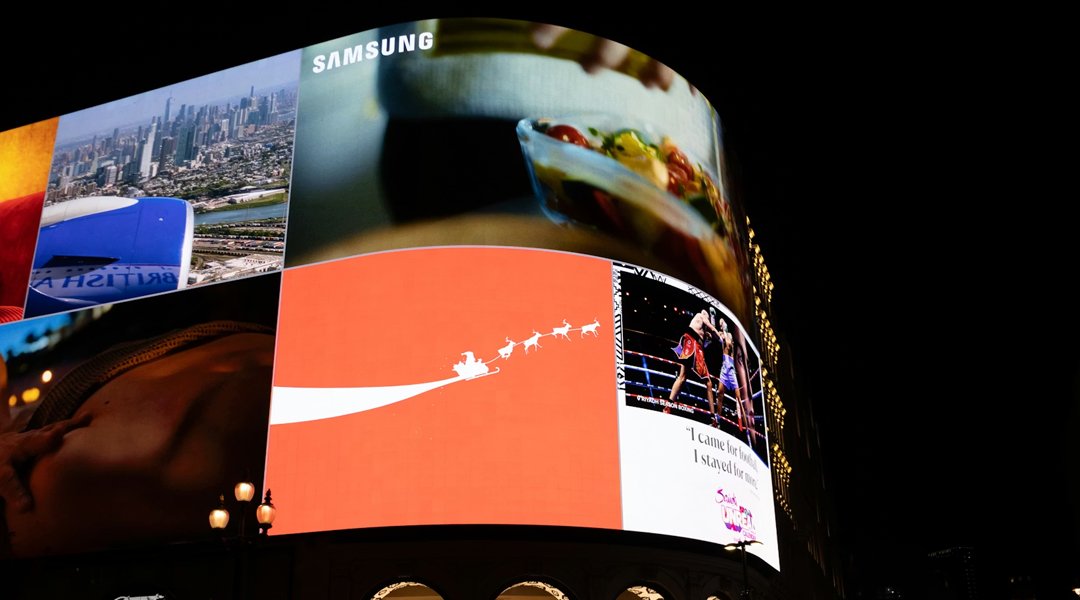
Editor’s note: When screens move beyond personal devices and become part of building façades, retail environments and urban fabric, their role fundamentally changes. In public and commercial contexts, displays are no longer one-way information broadcasters; they become a “digital skin” that dynamically responds to context, reshapes pedestrian flows, unlocks commercial value and helps manage urban resources. This issue examines four scenarios—cinema, retail, corporate collaboration and smart cities—to show how screens are evolving from passive terminals into proactive space enablers.
I. The Cinema Revolution: LED Giant Screens Disrupt a Century-Old Model
By the end of 2023, Samsung Onyx—the pioneer of LED cinema screens—had exceeded 500 installations across 65 countries. The turning point arrived in early 2024 when Sony introduced a commercial Crystal LED giant screen system (CEDISIS), featuring a 1,000,000:1 contrast ratio and securing DCI certification. LED cinema screens moved from niche equipment to a mainstream option that meets the highest technical standards.
How the technology disrupts the economics and use case:
Traditional DLP projection depends on consumable light sources and periodic screen maintenance—bulb replacements every ~6 months and screen refurbishment roughly every five years. By contrast, solid-state LED cinema walls deliver several core advantages:
- Operating-cost restructuring: No projection booth, no lamp degradation, and—according to a Harkness Screens white paper presented at CinemaCon 2024—roughly 35% lower power consumption.
- Space and revenue uplift: Eliminating the projection room can add 2–3 rows of seats. High sustained brightness (up to 300 nits or more in dark auditoria) enables new uses—e-sports, concerts and corporate events—beyond traditional screenings.
- Immersive format innovation: Examples such as CJ CGV’s ScreenX paired with 4DX LED demonstrate how multi-sided LED canvases synchronized with dynamic seating and environmental effects create experiences that cannot be replicated at home.
“This isn’t just an upgrade, it’s a paradigm shift,” said David N. Keighley, President of the International Council of Cinema Technologies (ICTA). LED screens transform cinemas from passive projection rooms into active light sources, enabling absolute blacks, unprecedented peak brightness and a new ‘theater-as-a-service’ business model.
Market outlook and challenges:
Omdia forecasts that despite initial costs being 4–5× higher than traditional projection, the professional cinema LED market will grow at a 22% CAGR through 2028 to roughly $1.8 billion, driven largely by new premium complexes in the Asia-Pacific region. The central technical and creative challenge remains content adaptation: most film masters are graded for projector gammas and brightness ranges, necessitating specialized post-production workflows or real-time tone mapping for LED canvases.
II. Retail Space Restructuring: Transparent Displays and the Digital Convergence of People, Goods and Place
At Sony Park in Ginza, a 6-meter transparent OLED (≈40% transparency) overlays physical merchandise with contextual digital information. At Selfridges in London, smart mirrors in fitting rooms identify held items, recommend outfits, simulate color changes and enable direct online checkout.
How displays reshape retail logic:
- Window displays as data capture points: Transparent OLED and mini-LED windows serve as storefront displays by day and interactive billboards by night. When combined with privacy-compliant visual sensors, they anonymously capture stop rates, dwell time and posture-based demographic estimates—turning foot traffic into actionable analytics. According to Yano Research Institute, the transparent display market in retail is projected to reach $420 million in 2024, with apparel and luxury sectors accounting for over 45% of use cases.
- Shelves and mirrors enabling instant commerce: Electronic shelf labels (ESLs) are evolving from monochrome e-ink to small full-color LCDs that show videos, inventory and ratings. Amazon’s “Just Walk Out” stores take this further: ceiling-mounted cameras and sensors act as a distributed visual system, tracking product movement and converting an entire store into an interactive, checkout-free environment.
“Successful retail displays minimize friction in the shopper journey—from seeing to buying,” says Christian D. Davies, CTO of the National Retail Federation. In optimized deployments, screens act as hubs that connect product data, inventory, staff and consumers—merging the warmth of in-store service with the efficiency of online conversion.
III. Corporate Space: From Meeting-Room Screens to Distributed Collaboration Canvases
Hybrid work has accelerated systematic upgrades to meeting spaces. Google’s Campfire rooms use circular layouts and multiple vertical displays to maintain natural eye lines between local and remote participants, while Microsoft Teams Rooms employs smart cameras and AI composition to foreground speakers and shared content.
Notable trends:
- Wireless, cloud-centric workflows: Products such as Barco ClickShare and Cisco Webex Desk Hub let any device wirelessly push content to room displays with one click; heavy lifting—processing, collaboration and rendering—moves to the cloud.
- Displays as room operating systems: Platforms like Samsung Flip Pro and Chromebox-integrated meeting systems combine display hardware with compute and AV processing, giving users immediate access to collaboration tools without needing a separate PC.
- Space-use analytics: Meeting-room cameras and sensors can anonymously measure attendance, duration and utilization, driving smarter facilities management. Frost & Sullivan projects that by 2025, more than 60% of medium-to-large enterprises will deploy intelligent collaboration systems in at least 30% of their meeting rooms.
“We’re moving from a tool-centric to a space-centric mindset,” said Smitha Hashim, Chief Product Officer at Zoom. Enterprises now seek immersive workspaces that link headquarters, branches, homes and mobile workers. The screen becomes the physical anchor that senses participants, surfaces relevant content and orchestrates the visual layout.
IV. Smart Cities: Giant Displays as the City’s Intelligent Skin
Iconic LED billboards have long defined Times Square, Shibuya and Piccadilly. The next generation of urban screens plays a more substantive infrastructure role:
- Traffic and emergency management: Smart roadside displays in Singapore integrate with traffic control systems to show diversion routes during incidents while pushing updates to connected vehicles via V2X communications.
- Environmental visualization: Copenhagen’s “City Circles” pairs circular LED installations with air-quality, noise and emission sensors to render invisible environmental metrics into accessible, real-time visual patterns—boosting public awareness.
- Public safety and community interaction: Smart streetlight poles with embedded displays provide navigation and news in normal conditions and switch to evacuation or emergency messaging when needed. ABI Research projects that shipments of displays integrated into streetlight poles will more than triple between 2024 and 2030.
“The city’s digital skin must be context-relevant and resilient,” says Carlo Ratti, Smart Cities World Expo Advisory Committee member. Screens should avoid meaningless visual clutter and instead deliver location- and time-sensitive information. They must also meet infrastructure requirements—high brightness, broad operating temperature ranges and robust cybersecurity—to function reliably in extreme conditions and serve as emergency communications nodes.
Expert Perspective
“In public and commercial spaces, display technology’s value model has been remapped. Price per square meter is no longer the sole metric; success is measured by commercial revenue per square meter, operational savings and improved urban-management efficiency. Screens become “intelligent pores” in the built environment—sensing, displaying, interacting and even executing actions such as directing traffic. Winning suppliers will provide end-to-end intelligent space solutions: hardware plus sensors, software and analytics that together deliver quantifiable commercial and social value—rather than supplying standalone, visually impressive panels.” — Paul Gagnon, Senior Research Director, Display Research Practice, Omdia (15+ years focused on commercial displays)
All articles and insights of the Special Edition of Smart Display
(#1) The Evolution of Display Technology: The Underlying Logic from LCD to Micro-LED
(#2) Beyond Display: Integrating Sensing, Interaction, and Computing into the Screen Itself
(#3) Reshaping Personal Space: A New Chapter in the “Screen Narrative” of Consumer Electronics
(#5) The Hidden Trump Card in the Supply Chain: The Battle Between Materials, Equipment, and Chips
(#6) Business Model Battle: From Panel Manufacturing to Ecosystem Building
(#7) Display Industry from a Capital Perspective: Undervalued Opportunities and Innovation Hotspots
(#8) After the Interface Disappears: When the Display Blends into the Environment